
 English
 Español
 Français
 Português
Discover our 25G product range for your applications

Discover our 25G product range for your applications!
Datacenters are in constant expansion, requiring ever higher capacity and bandwidth. To meet the increasing demand, datacenters are migrating to 25G Ethernet technology by installing 25G optical transceivers, AOCs (Active Optical Cables) and DACs (Direct Attached Cables) in their infrastructure.
A 25G transceiver is commonly called SFP28 and is an enhanced version of the well-known 10G SFP+. The SFP28 is physically identical to the SFP+ but with its electrical interface upgraded to support 25G data rates. While the SFP+ comes in plenty of variants, the SFP28 comes with only a few like SR, LR and bidi. Of course, the number of variants is now increasing with the increasing number of deployed 25G ports.
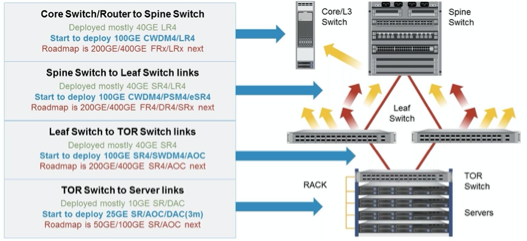
Datacenter Application
25G SFP28 are mainly used today in Top-of-Rack (ToR) configurations. Indeed, the 25G SFP28 offers a smooth migration from 10G to 25G using existing fiber installations for people working with 1/10G or 10/25G servers.
Enterprise Application
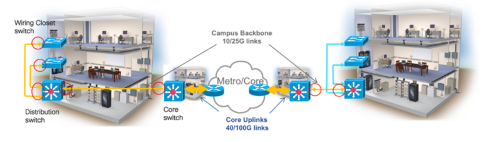
With video conferencing and business applications increasing so fast, enterprises have no choice but to upgrade their backbone networks from standard 10G to higher data rates. Being compatible with their legacy 10G equipment, the 25G SFP28 transceivers are the best solution to increase bandwidth allowing enterprises to use the existing infrastructure and save money.
Mobile Application
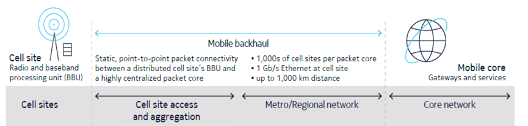
- Classical” backhaul
- Centralized RAN and fronthaul
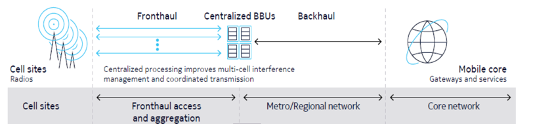
Mobile Fronthaul allows for network cost reductions by moving power consumption from the towers. Co-location of BBUs saves power as capacity can be reallocated depending on traffic load. Latency is reduced as switching and routing functions are moved from the towers deeper into the network.
The connection between centralized BBUs and cell sites (≥ 20km*) can be either based on CPRI or eCPRI protocols.
The links (one per sector and carrier) can be either TDM (dual fibre), BiDi (single fibre) or xWDM. Data rates up to 25G (25GE or CPRI option 10) are envisioned. Connections at 50G are being considered in Asia.
* Limited by roundtrip latency
Standards
With new technology comes new standards. The below are the current IEEE standards in place or considered for 25GBASE SFP28 transceivers
| SR (802.3bm-2015) | LR (802.3cc-2017) | ER (802.3cc-2017) | |
|---|---|---|---|
| Media / Configuration | MM /Dual | SM / Dual | SM / Dual |
| Reach | £ 100m* | £ 10km* | £ 40km* |
| Fiber Count | 2 | 2 | 2 |
| Optical Lanes | 1 (850nm) | 1 (1310nm) | 1 (1310nm) |
| Data Rate per Lane/ Modulation | 25Gbps/NRZ | 25Gbps/NRZ | 25Gbps/ NRZ |
| BR-10 (P802.3cp) | BR-20 (P802.3cp) | BR-40 (P802.3cp) | BR-40+ (P802.3cp) | |
|---|---|---|---|---|
| Media / Configuration | SM/Single | SM/Single | SM/Single | SM/Single |
| Reach | £ 10km* | £ 20km* | £ 40km* | £ 40+km* |
| Fiber Count | 1 | 1 | 1 | 1 |
| Optical Lanes | 1 (1270/1330nm) | 1 (1288/1314nm) | 1 (1288/1314nm) | 1 (1288/1314nm) |
| Data Rate per Lane/ Modulation | 25Gbps/NRZ | 25Gbps/NRZ | 25Gbps/ NRZ | 25Gbps/NRZ |
* FEC (Forward Error Correction) is mandatory
Sources:
- Latest Trends in Data Center Optics
- Fiber Optical Networking: 25g-sfp28-transceivers-applications
 Data Sovereignty Begins at the Hardware
 High-Performance Optics for the Memory Crunch
 Celebrating 4 Years as Part of the Amphenol Family
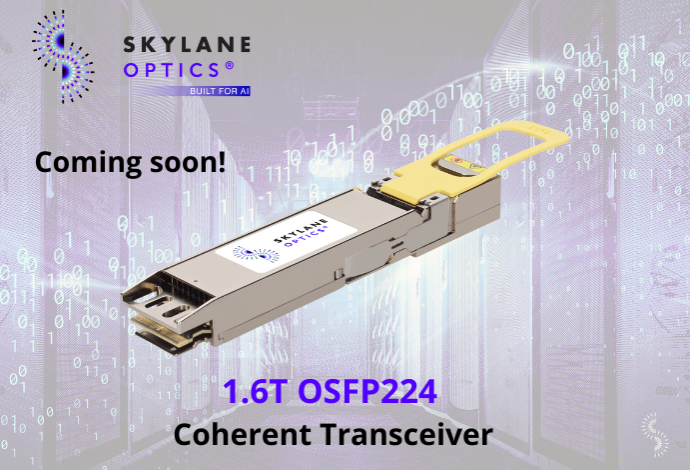 A New Era: 1.6T OSFP224 2xDR4 Transceivers
 Expand Your Optical Network with EDFAMUX